• mood bleary
  • reading devtools
  • listening all at once - ninajirachi

neocities

Websites change when one begins to look first and inspect shortly after. This is how I discovered iframes. Iframes bridge an HTML page to another HTML page. Web widgets/embeds operate with this logic. I like Jekyll’s post infrastructure, and iframes allow me to deploy content via boxhouse and bridge it to my neocities. boxhouse has leaned towards being a repository as I work which is not surprising as I want to understand and operate servers.

I fished up CSS grids as I worked on my website too. I like precision in layout placement. I visualized my neocities site on a grid and hadn’t recognized I could declare a grid on top of the entire viewport. I work with 32x32 and have been having a lot of fun since things finally make sense. I am nervous I lean too far into grids so I try to identify where flex works too.

As I browsed the web, I began to solidify how I understand my website. I like the scaled-back visual with limited reactivity because any strong visual flare relies on complex code, and I would rather focus on that sort of code when I am studying low-level (i.e. linux) or software (i.e. front-end interfaces with cmdline tools) programming. I think my colours are formalizing too but I change a lot.


ffmpeg and gifsicle

dithered miku Digital things are made to be transformed. My computer can run software that transforms things so they fit my aesthetic. For example, I found a gif that I liked a lot, but it was too bright and lacked an alpha layer.

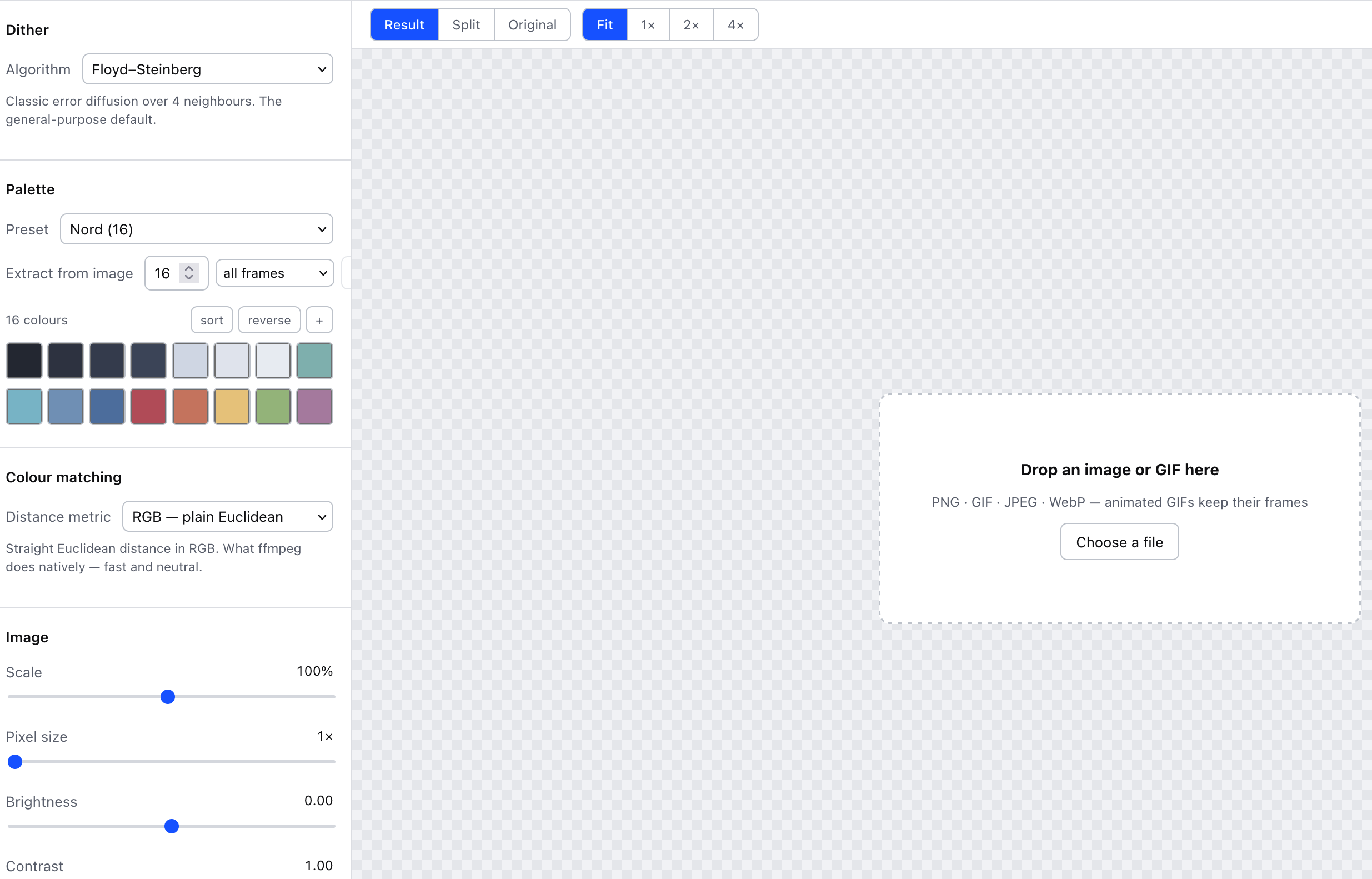
Gifsicle is open-source software that processes gifs: one command in the terminal and the gif now had its alpha layer. From here, launched my dither tool and voila.

For my dither tool, I also had claude implement a custom colour palette. It’s been fun to play around.


blender

The lain gif that sits atop of my navi has been a big inspiration because I love it so much. I want to make my own gifs. I am not an artist but I do sketch every day and I have a simple mascot I call albertines. albertines are simple, so I figured I should poke around in blender. albertines Claude assisted me in some config and I began to shape a circle into another shape. Unfortunately, blender requires a mouse (lol). I’m focused on drafting dimensionality into the albertines for now.


cmdline

I have three more tools are my fingertips. As this number grows, I lose track of what tools I have, partly because I need to remember long paths. I config’d some variables but these are also hard to remember at times, especially when time passes between use.

I think I might want to develop a sort of daemon that acts as a reference sheet for my terminal. This veers to shortcuts on a desktop, which I want to avoid. So I think I want to create a light-weight but cute UI that just presents the variable sections from my various config files.

  • mood catatonic
  • reading computer scr33n >:D
  • listening WannaCry

neocities

I want to use neocities because the social aspect seems fun. The raison d’etre of neocities is to revive geocities, so static website networks. Manual work and design excellence are important to the culture, it would be inappropriate if I used claude to generate a site. Besides inappropriate, I thought it wouldn’t be fun. I use claude to ask questions, remind me of things, and clarify details; so claude is like a textbook that talks back when I ask it a question (I’ve made this argument before).

My site is here.

The w3 grid layout resource clarified that some web design is thinking in boxes. Last night I placed four boxes with various elements—which I recognized as elements! I now had a visual layout along with a small inventory of primary elements that will structure my site. I ran into some issues with implementation. This came from two places: failure to understand css measurements (fr, rem, etc.), and failure to implement a :root element (which I have read about and played with and should know better!). After some upset exchanges with claude I found some moderate success and walked away from my home page.

At some point I switched out of the neocities editor and returned to vim, serving the site to port 8000. I do this with boxhouse too, but I didn’t realize it was a broader concept which is very fun. I had claude explain the connection which was really cool. Computers are like little worlds and that’s scary and not scary.

Neocities forbids its users to modify the metadata of the index file; frustrating because I was using vim. This is why users have landing pages (lol), so I switched my index to “home”, and made a landing page. I had no issue setting up the structure at first, though once it came to style and function I tripped up. I figured I’d need js (elementid -> listener for hover -> increase id size), but claude gave me a css solution which was fine.

From here on, I think I want my index to display some basic html, css, and js features so I have a quick reference. So, I will be going back to implement the current functionality as js (if I don’t completely rip things apart soon).


ffmpeg stuff

gif1

FFMPEG is a super cool suite of libraries and programs for transforming images, video, and audio. I used FFMPEG in the past and had plans to use it for data moshing. The tool dithermark can transform a video, so I wanted to do the same to a gif. Claude explained that ffmpeg can handle that. I had it write me a script which worked, but then I decided an application made way more sense.

An application made sense because the script required too much overhead which made use a little unbearable. I had claude code put together the app which serves locally (so python + js).

tool

This tool serves my needs really well, though I ought to understand it a little better. It may be interesting to inquire on its input-output lifecycle. Also, I can see a world where I put together some colour palettes and direct claude to set them in the backend, though I’m not clear how I can exert the control I would like (i.e. monochrome palette with two or three departures; obviously there’s a luminance calculation that would give me what I want but I don’t have that language!).

  • mood unsettled
  • reading last post
  • listening ambiance

visibility & my stoplight application

blythgif

Computers are magic in the sense that science is magic. Magic is dispelled with knowledge, but one requires a monumental amount of knowledge to dispel magic. Science is not difficult, just dark until one has illumination via information. A computer in containment is whatever, but sprawled out over the internet is O_O. I understand networking enough to know there is a lot I don’t know and consequently a lot to be scared of.

Alt spaces + treacherous internet = burst of energy which infused a project I began drafting earlier this year. The nice thing about computers is their firm materialism: there is no confusion about input or output, there is always an answer that accounts for everything. So my reason told me that I must be able to have some sort of vision over the outputs that appear on my computer. This is a dumb way to say network monitoring.

I turned to claude to develop a project plan that includes a defined mandate, a list of dependencies, the required architecture, and the actual steps for implementation. These items constitute a workbook that I’ll be reviewing when I have the energy. It also established my repo along with a gitignore (which I’ll also review in time).

Initially, I wanted this to be a raspberry pi project though the cost for the hardware here would be prohibitive and unnecessary since I only use one device. I’m keeping an eye out for raspberry pi projects (probably pico projects).

web tools

The shrines I am crafting require assets from across the web. These include structural materials (buttons, banners, favicons) as well as public official art. I understand that websites serve content as URLs, and my browser loads those URLs to interact. It stood to reason that these images are stored within directories on the webserver, so I figured there must be a way to receive a catalogue of images on particular websites.

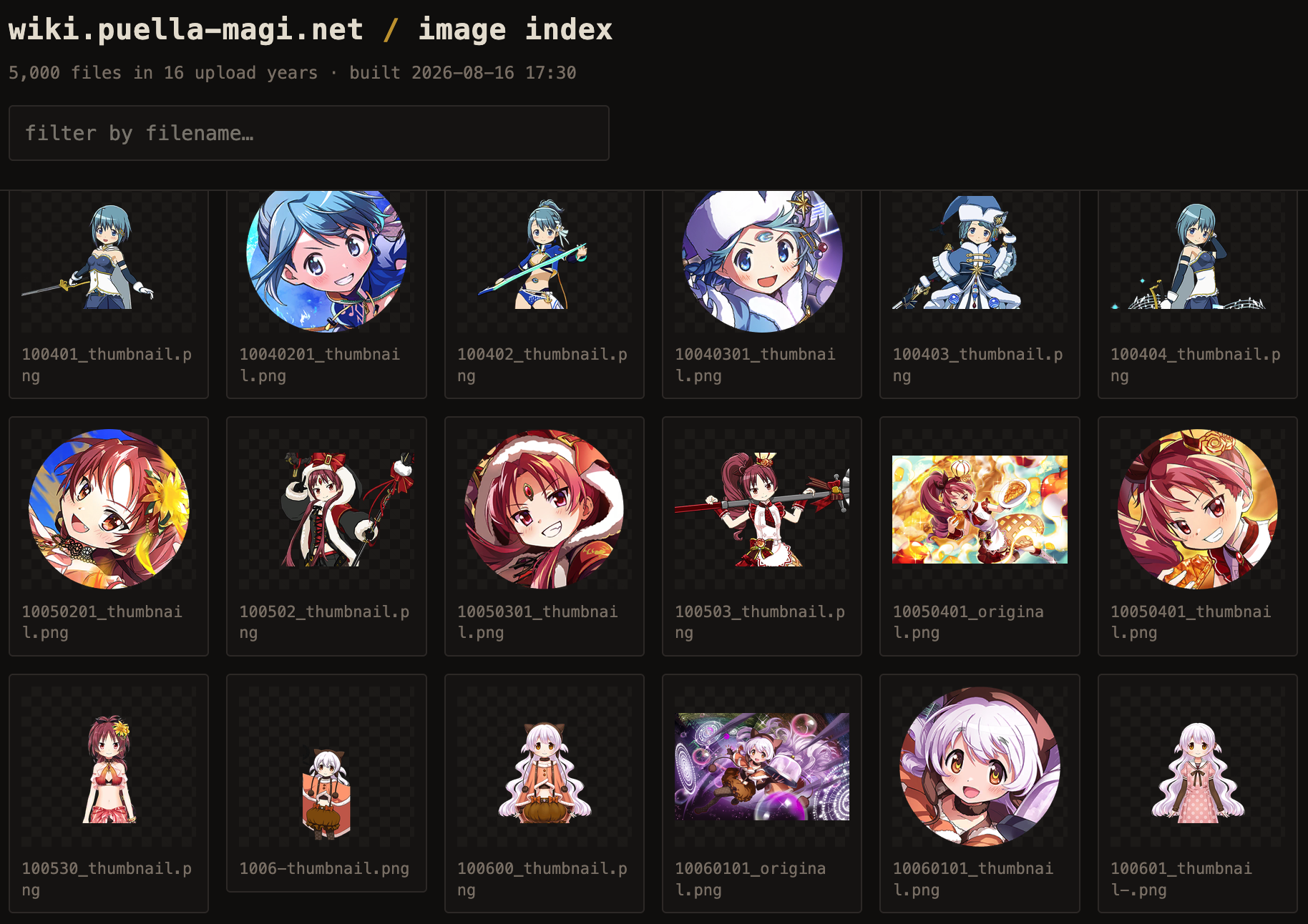
I put this to claude and it built me a python script that uses curl. This worked for an older website, but did not for a newer one. This has to do with how the information is stored. From here, a prompt led to relying on the wayback machine which works but risks pulling waaaaay too much information. The Puella Magi wiki returned 12,000 images and was only 18% finished. A prompt led to adding a limit param and voila.

results

This works for any website and outputs an html of webarchive URLs which I find helpful. There are obvious drawbacks. My follow-up includes:

  • Clarifying the consequence of this sort of query.
  • Develop the HTML to organize by a point in the address.
  • Limit the number previews loaded by the page.
    • mood pointy
    • reading various websites
    • listening ambiance

    dNcincat

    In July I updated boxhouse. The direction came from developments in my philosophy on the way my body and my brain influence my mind + how to manage the outputs. In August I decided to update boxhouse again. This second update originated from a desire to display buttons.

    Within this time frame, I also deleted my tumblr and my instagram accounts. It was shortly thereafter that I turned back to my website (this and a stress response). Notably, I’m interested in imageboards right now though I’ll save that for the next log.

    I am writing this on 16 August.


    process

    I use Claude extensively. I browse the internet for inspiration. This may include layouts or themes or aesthetics. I then enter into a prompt discussion with Claude to develop the form that I can fit my substance into.

    how ai factors into my workflow

    I haven’t had a reason to use claude to develop any substantial content that isn’t wholly referential. I think this just depends on what an individual considers worth their time. I want to write and sketch, to collect fun digital stuff, and to think; I don’t want to struggle with the constraints of coding languages.

    I use ai to overcome the things I don’t want to do, but that block expression. For example, my next task I will be asking claude to handle will be wiring my ongoing box (I put in the html/cscc stuff but it isn’t functional yet) and code my log pages to take images as a background. I could certainly learn how to do these things, but if I can use claude as an interface between me and my website then that means I’m free from the pedagogical restraints/pressures that would result from learning those operations on my own (ignoring the fact that it wouldn’t take me that long to learn because I already understand the logic without the proper syntax).

    boxhouse direction

    The top priority for boxhouse’s root is presentation of a directory along with a generalization of my aesthetic. As I explored other websites, I realized that I can have numerous designs inside of my website (duh). This led me to map out some shrines and logs. Shrines orient around one thing that I worship. Logs orient around the things I do.

    cat

    My root site is now a directory for the information I manage (lists, writings, photography). I also have a subdirectory for computer stuff like the things I collect (buttons, resources). My background are cool too and they make me happy c:.

    My madoka shrine provides a good example of how I use claude. I liked this template from FOOL LOVERS (i-019), so I provided it to claude in a prompt along with my other ideas. Similarly, the shape of my root site comes from n-007) in sort of the same manner.


    buttons

    I like buttons a lot because they are like crystallized irony, or they are very cute. Either way, they make me happy and I really enjoy opening my site so I can see which three appear in the footer.