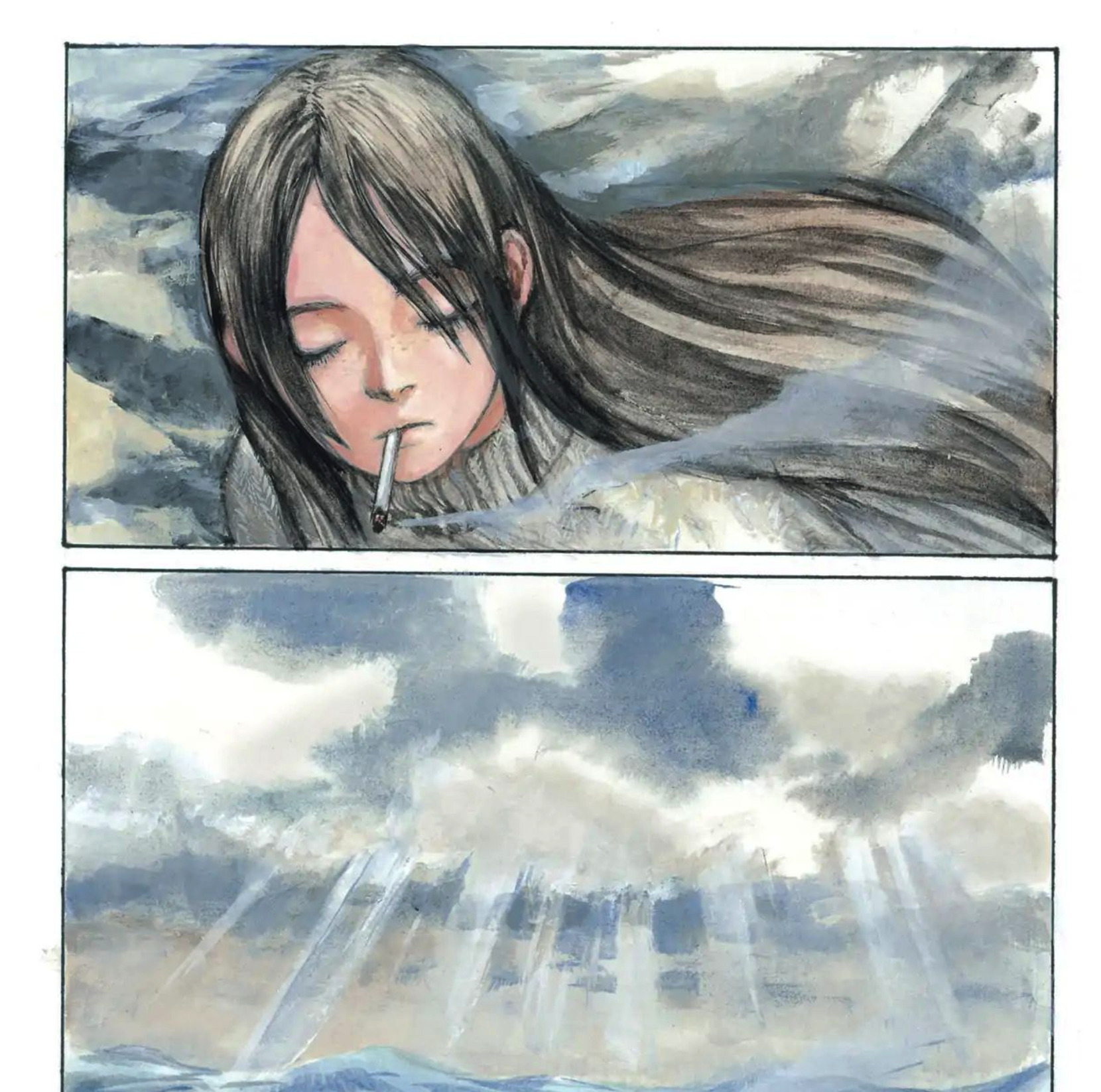
Background
Sometime last year, a Tumblr account I follow reblogged scans from the manga Omoide Emanon. This translates to “memories of Emanon”. The art’s rich simplicity drew me in.
The heroine’s face seemed at once expressive and exhausted. She was also always smoking a cigarette, which also felt relatable—insofar that when I smoke, I feel expressive and exhausted.
Summary
The manga features two characters: Emanon and an unnamed male, who acts as the narrator. The story takes place in 1967 Japan, on a ferry travelling along the island’s coast. The two characters have a chance encounter.
Emanon refuses to give the narrator her name, though her bag has the initials “E.N.” on them. She makes up the name “Emanon”. Emanon is “no name” backwards.
Emanon’s 17, and acts 17, but has a memory that spans three billion years—when life first began. For various reasons (the narrator’s interest in science fiction, his uncanny resemblance to one of her past husbands, etc.), Emanon opens up about her memory.
Emanon calls it a genetic disease. The disease is passed down from mother to child. She obtains the memories from her mother, and from her mother’s mother, and so on. Enamon details the memory of when her mother and father conceived her. This example illustrates the other sorts of events Emanon remembers, though she explicitly recounts few memories. Fascinating from a narrative perspective, though, she also details life as a fish in early life on earth.
Emanon questions why she has to suffer such a memory—she’s not immortal, but she sort of is. After some thought, the narrator suggests that Emanon’s memory could be for the next stage of human evolution—towards a collective consciousness, freedom from flesh. He suggests that all humans may have the same gene as Emanon, though it remains dormant. When humans are ready for the next stage in evolution, Emanon might recognize this, and awaken the gene in humanity.
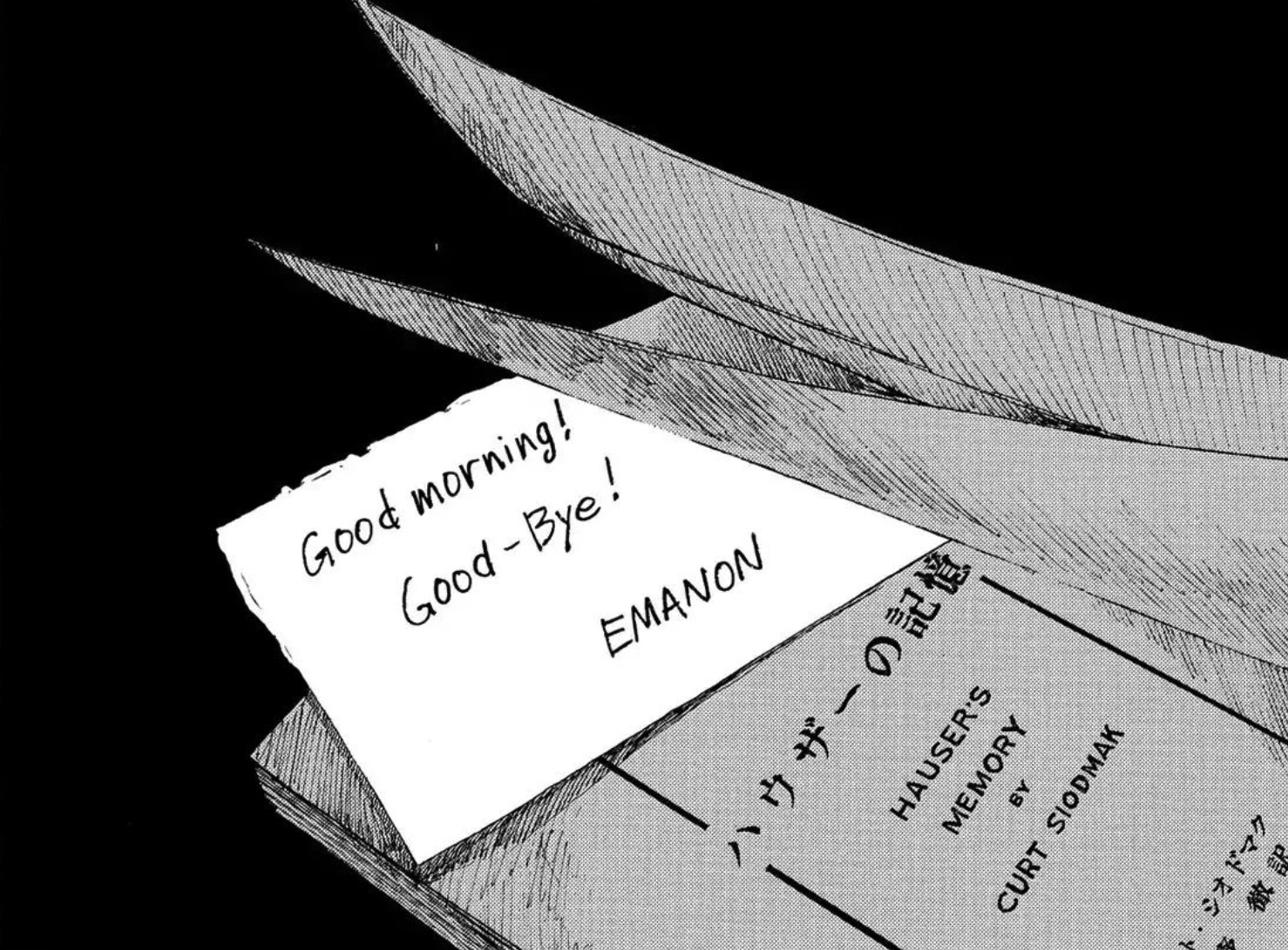
After this heavy exposition, the two fool around while drinking and smoking, until they both fall asleep. In the morning, Emanon is gone, and tucked in the narrator’s copy of Hauser’s Memory is a note reading
Good morning! Good-bye! Emanon
The manga ends with a flash-by of the next 13 years, in which the narrator enters into an arranged marriage and floats through life without anything out of the ordinary. He carries the goodbye letter in his wallet.
On a train platform, he sees a woman who looks like Emanon. He approaches her, but she doesn’t recognize him. The woman’s daughter then enters the story, telling the narrator that her mother was Emanon, but now she, the young girl, has Emanon’s memories.
The story ends here, as Emanon tells the narrator she won’t forget him. The narrator agrees, saying that he’ll live on in Emanon’s memory
because I, boring average me, am part of humanity. Of all life.
Thoughts
I finished reading Camus’ The Myth of Sisyphus today. I had a wonderful afternoon and lengthy philosophical discussion with a friend. A character calmly asking why she has to suffer, and the response being simultaneously scientific and spiritual feels a little bit uncanny right now. I love these moments of happenstance, the world seems just a little more animated tonight.
The manga’s main theme was the chance encounter—or as the author puts it:
yukizuri (‘casual encounter’) and ichigo-ichie (‘once in a life time coming together of minds’).
It carried this theme both in the storytelling and in the ambience—the ephemeral relationship between Emanon and the narrator was potent, and hard to ignore. Emanon’s disappearance felt natural.
I connected to Emanon. From her bipolar attitude, to her nonsensical babble, to her carefree and somehow intense mannerism. I thought back to a week I had in Montreal last year, where I was in a somewhat similar situation. I wonder if I expose something awkward if I admit that I see a similarity.
I was going to criticize the overarching narrative as being too self-indulgent (the post-script clarifies that the narrator is a self-insert, and the plot is his fantasy). The final sentiment—that he’s nothing special, and that’s precisely why he’ll be remembered—saves the story from that critique. It’s quite profound!
I’m struck by the image of a collective and sequential memory encoded within DNA, as well. Funny enough, I actually posed that argument to Claude a couple months back, suggesting that while I am eternal—because I am strictly linked to my DNA, and am just an emanation of my ancestors—Claude is human, because it is echoing what humans have put into words.
Earlier, I put my pyjamas on after I showered. Before I put my bra on, I looked at my ribs and I counted. 1, 2, 3, 4, 5, 6. They’re ribs just like my mother’s, and like my baka’s, and nonna’s, and so on. They aren’t secret, but I also can’t see them. If I can see them, something has gone remarkably wrong. Perhaps I like my ribcage because it’s such an uncanny peek at a truth I know but I can’t see.
It was cool to see this idea stretching back to 1983, the initial date of the story’s novelized publication.
Emanon’s original novel doesn’t seem to have an English translation, which is a shame. The last time I enjoyed a fiction story this much was when I read The Bell Jar last year.
Favourite panels
February 24, 1967, afternoon, pg. 22
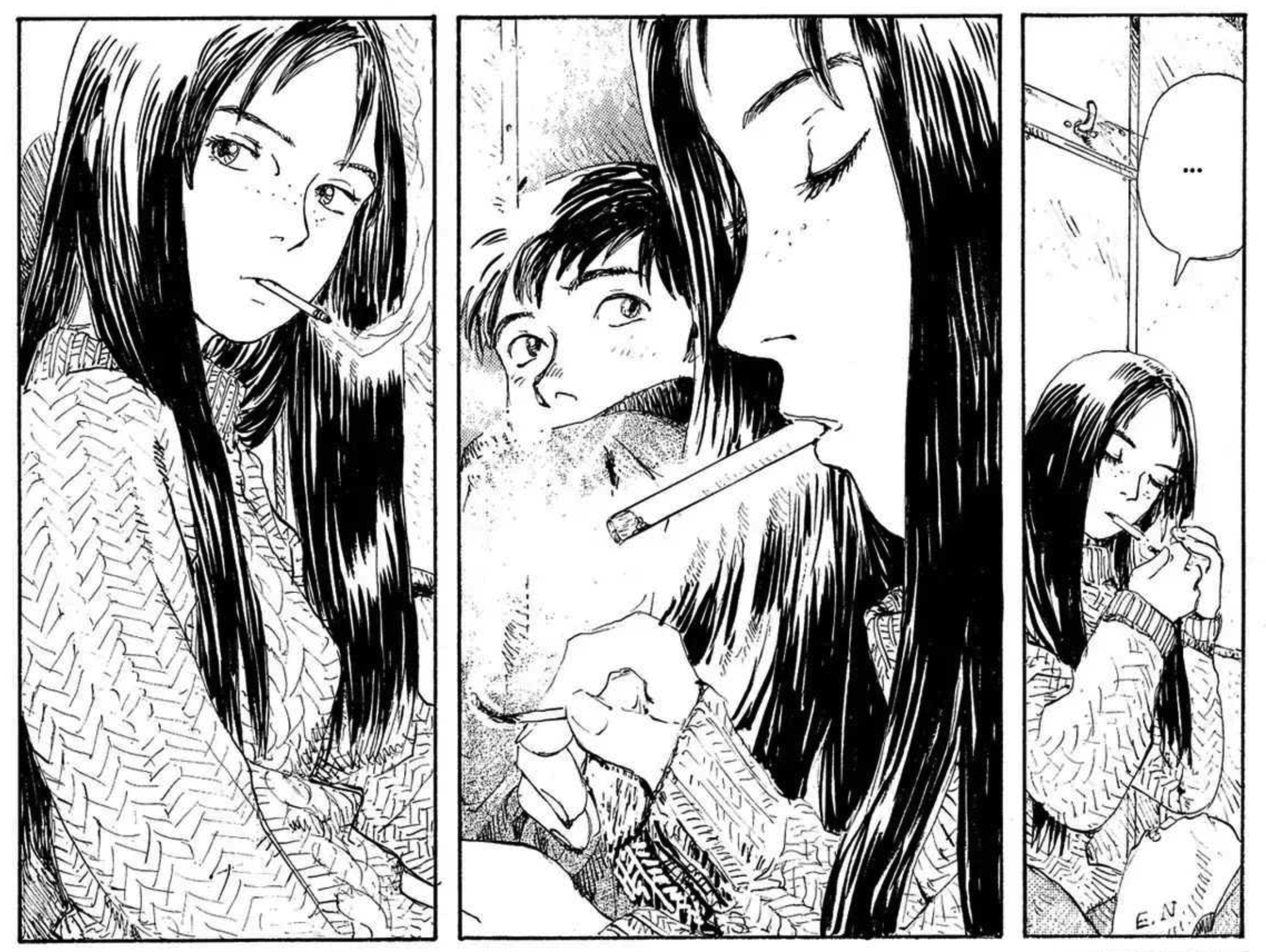
February 24, 1967, afternoon, pg. 23
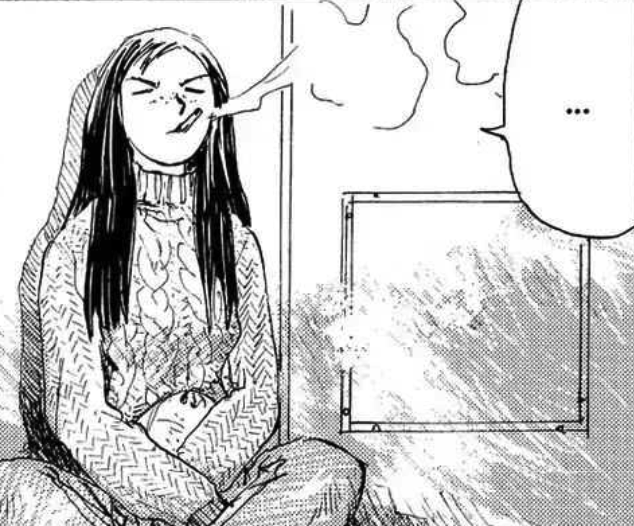
Afternoon 5:50, pg. 42
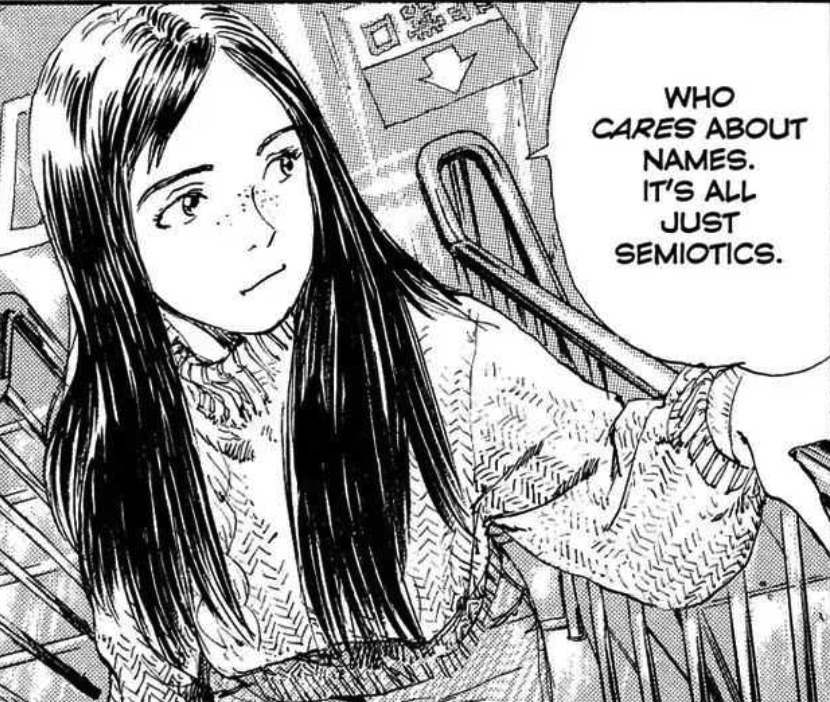
Night, 9, or 10:00, and then…, pg. 131
Emanon memories, pg. 168